Pride Flags and Their Meanings: All 28 Flags, With Colors
A guide to pride flags and their meanings — all 28 LGBTQ flags with exact hex color codes, brief histories, and how to turn any of them into a profile picture.
Pride flags and their meanings can feel like a lot to keep track of — there are dozens of designs, each with its own history, its own colors, and its own community behind it. This guide covers all 28 pride flags we support in our free LGBTQ PFP maker, grouped so they're easy to browse: the umbrella flags most people recognize, the orientation flags, and the gender-identity flags. For the most-searched designs you'll also find exact hex codes, so you can use the real colors anywhere — in art, in a Discord role color, or in your next avatar.
One note before we start: flag histories are community histories. Many of these designs came out of forums, Tumblr polls, and grassroots campaigns rather than official committees, and some flags have several variants in circulation. We've stuck to the most widely used versions and the facts that are broadly documented.
The Umbrella Flags
These are the designs that represent the whole community, and the ones you'll see most during Pride Month.
- Rainbow Pride — descended from Gilbert Baker's original 1978 San Francisco design, today's six-stripe version uses red (#E40303), orange (#FF8C00), yellow (#FFED00), green (#008026), blue (#24408E), and purple (#732982). Each stripe carries a meaning from Baker's original concept — life, healing, sunlight, nature, harmony, and spirit. If you only know one pride flag, it's this one.
- Philadelphia Pride — the city of Philadelphia added black (#000000) and brown (#784F17) stripes above the rainbow in 2017 to explicitly include LGBTQ people of color.
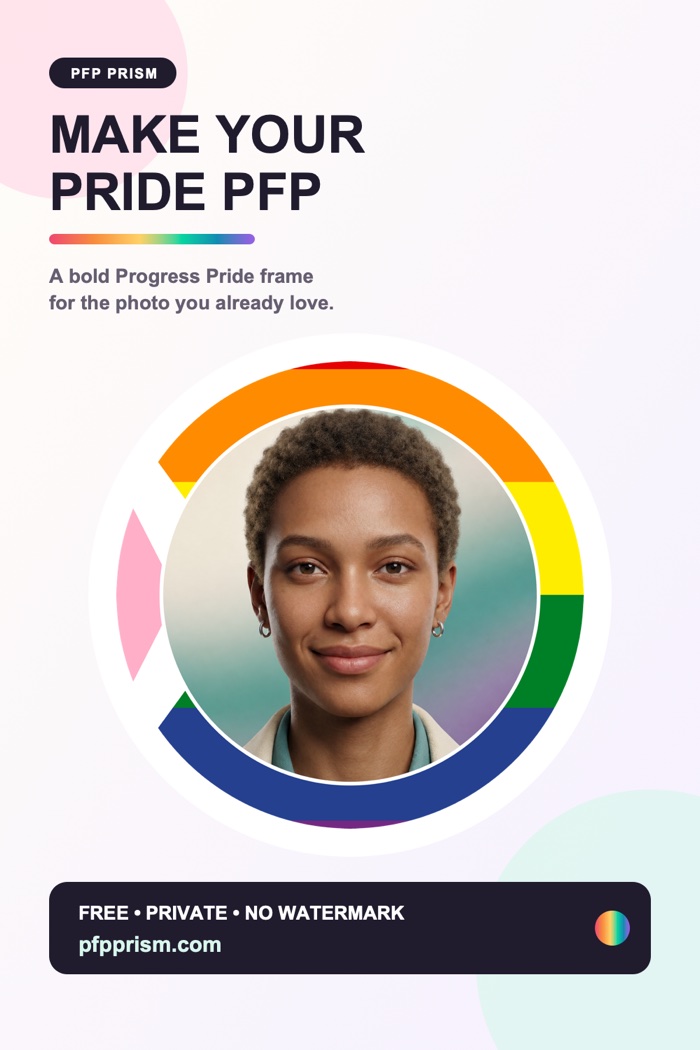
- Progress Pride — designed by Daniel Quasar in 2018, it keeps the six rainbow stripes and adds a forward-pointing chevron with white, pink, and light blue (for the transgender community) plus brown and black stripes (for people of color, and in memory of those lost to AIDS). The arrow shape points right: progress still being made.
- Intersex-Inclusive Progress — Valentino Vecchietti's 2021 update adds the intersex flag's yellow field (#FFD800) and purple circle (#7902AA) to the Progress chevron. It has quickly become the default flag at many official Pride events.
Any of these four makes an instantly recognizable avatar. If you want the classic look, the six-stripe rainbow as a ring around your photo is the single most popular choice in our maker — our pride PFP guide walks through it step by step.
Orientation Flags
- Lesbian (5-stripe "sunset") — dark orange (#D52D00), light orange (#FF9A56), white (#FFFFFF), pink (#D362A4), and dark rose (#A30262). The warm-to-cool sunset gradient emerged from community redesigns around 2018; a 7-stripe version with two extra tones is also widely used, and we include both. More ideas in our lesbian PFP guide.
- Gay Men (MLM/Vincian) — a green-to-purple gradient (teal #078D70 through white to indigo #3D1A78) that emerged online around 2019 as a flag specifically for men who love men.
- Bisexual — created by Michael Page in 1998: magenta (#D60270), purple (#9B4F96), and blue (#0038A8) in a 2:1:2 ratio. The overlap color in the middle is the point — attraction across genders. See the bi PFP guide for style tips.
- Pansexual — hot pink (#FF218C), yellow (#FFD800), and cyan (#21B1FF), dating to around 2010. One of the boldest palettes of any flag.
- Asexual — from the AVEN community in 2010: black (#000000), grey (#A3A3A3), white (#FFFFFF), and purple (#800080), representing the asexual spectrum and community.
- Aromantic — greens (#3DA542, #A7D379) for aromanticism, white, then grey (#A9A9A9) and black for the spectrum of romantic experience.
- Aroace — an orange-to-blue design (#E28C00, #ECCD00, #FFFFFF, #62AEDC, #203856) for people who are both aromantic and asexual. All three of these spectrum flags are covered in our asexual and aromantic PFP guide.
- Polysexual — pink (#F714BA), green (#01D66A), and blue (#1594F6): attraction to many, but not necessarily all, genders.
- Omnisexual — pinks and blues around a deep violet center (#200044), for attraction to all genders where gender still plays a role in the attraction.
- Abrosexual — a green-to-pink gradient for people whose orientation is fluid and changes over time.
Gender Identity Flags
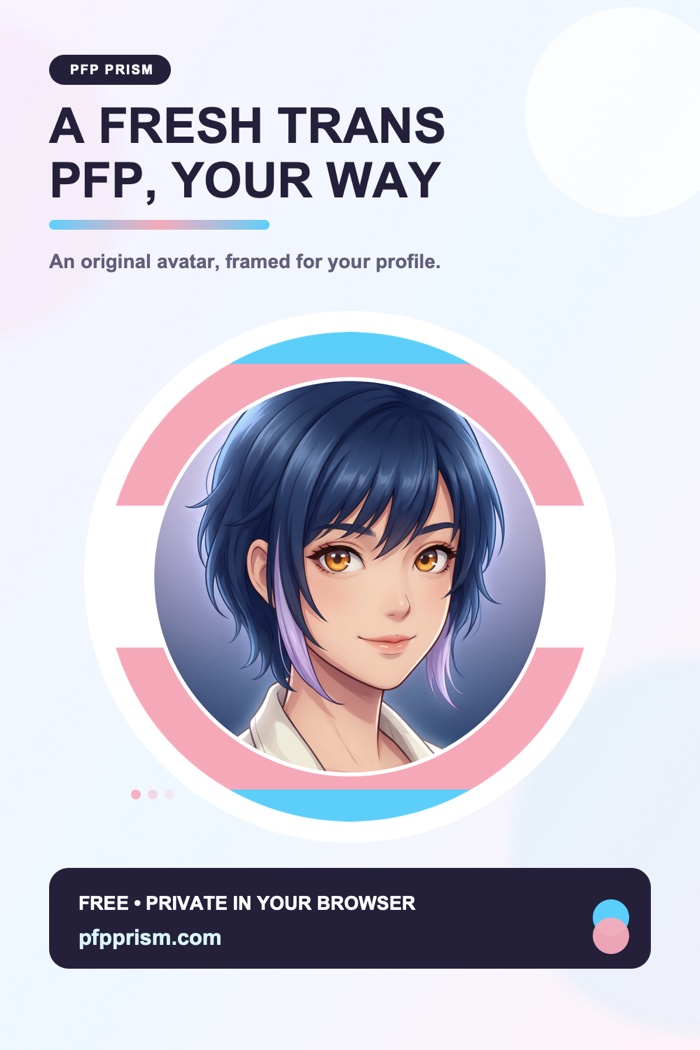
- Transgender — one of the most recognizable flags in the world, created by Monica Helms in 1999: light blue (#5BCEFA), pink (#F5A9B8), and white (#FFFFFF) in a symmetric five-stripe layout. The symmetry is intentional — the flag is correct whichever way you fly it. Our trans PFP guide has palette-specific avatar tips.
- Nonbinary — created by Kye Rowan in 2014: yellow (#FCF434) for gender outside the binary, white for many genders, purple (#9C59D1) for mixed genders, and near-black (#2C2C2C) for the agender experience.
- Genderqueer — lavender (#B57EDC), white, and chartreuse (#4A8123), predating the nonbinary flag as an umbrella for queered gender.
- Genderfluid — five stripes (pink, white, violet, black, blue) for the range of a fluid gender experience.
- Agender — a symmetric seven-stripe design in black, grey, white, and green (#BAF484); the green stripe represents nonbinary gender, the black and white the absence of gender.
- Bigender — pinks and blues meeting around white, for people with two gender identities.
- Demiboy and Demigirl — grey-based symmetric flags with a light blue (#9DD7EA) or pink (#FDADC8) center accent, for partial connection to a gender.
- Pangender — soft yellows and pinks around white, for experiencing many or all genders.
- Intersex — Morgan Carpenter's 2013 design: a purple circle (#7902AA) on a yellow field (#FFD800). Both colors were chosen for being outside the pink/blue binary; the unbroken circle stands for wholeness.
Community and Culture Flags
- Demisexual and Demiromantic — a black triangle at the hoist with a thin purple (#6E0070) or green (#3DA542) stripe, for attraction that forms only after a deep bond.
- Bear Brotherhood — earth-toned stripes from the bear community within gay male culture.
Turning Your Flag Into a Profile Picture
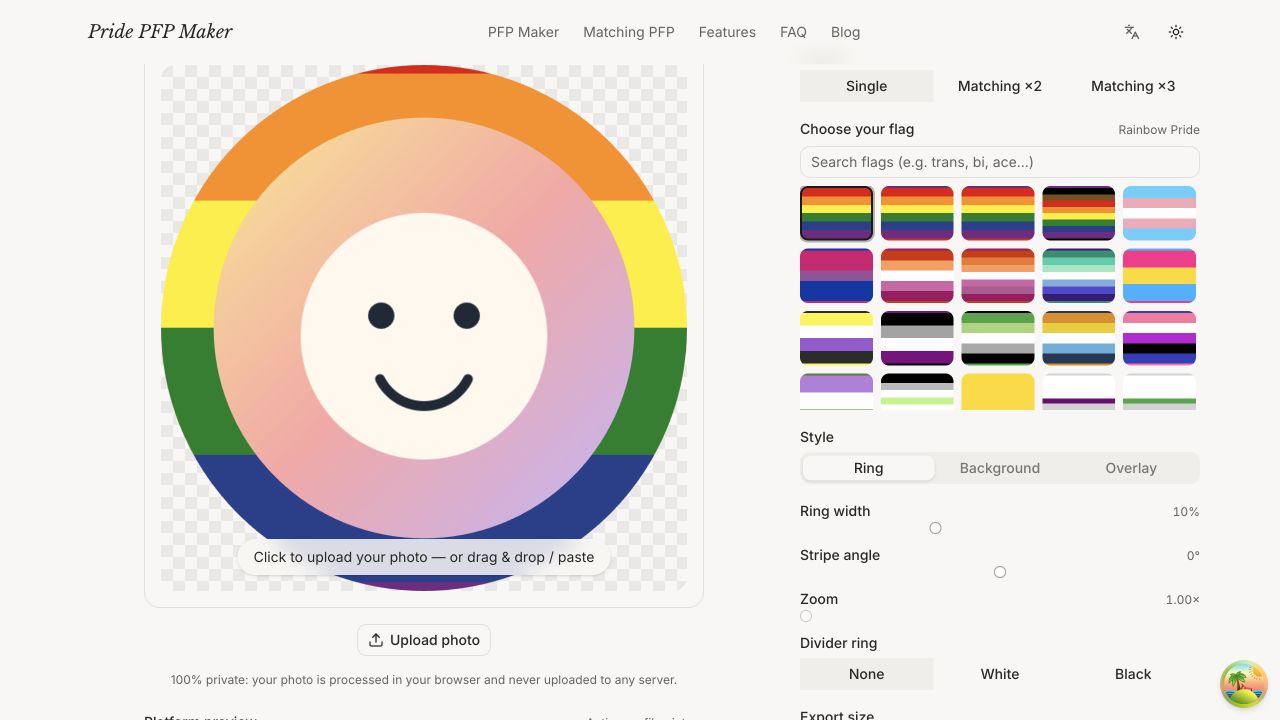
Knowing your flag is half the fun — wearing it is the other half. Every flag on this page is built into our pride PFP maker with the exact colors listed above, drawn as crisp vector stripes rather than compressed images. Making an avatar takes under a minute:
- Open the free PFP maker and upload any photo. It's processed entirely in your browser — your photo never leaves your device.
- Search your flag by name ("trans", "aroace", "nonbinary"...) and tap it.
- Choose a style: a flag ring around your photo, a full flag background, or a subtle overlay. Our border guide explains when each works best.
- Adjust the ring width, stripe angle, and zoom, then download a free HD transparent PNG — no watermark, no signup.
Making avatars with a friend or partner? The matching PFP maker splits one photo into two or three connected avatars, and each person can carry a different flag.
Which pride flag should I use?
Whichever one feels like yours — and it's completely fine to use more than one, or to just use the rainbow. Identity words and flags are tools for you, not tests to pass.
Are these the "official" flag colors?
There's no single governing body for pride flags, so "official" is fuzzy by nature. The hex codes above are the most widely documented values, and they're exactly what our tool renders.
Can I combine two flags in one PFP?
Yes — use the matching layout to give different pieces different flags, or angle two exports and combine them. Plenty of people also rotate flags through the year: rainbow in June, their specific flag the rest of the time.
Ready to put your colors on? Make your pride PFP now — free, private, and done in under a minute.
使用 Maker 制作的 PFP 灵感
参考这两个完成效果,开始设计你自己的骄傲头像。